Can you keep one today?
Rules as of October 11, 2026. Seasons open and close at midnight, Florida time.
- Gulf state and federal watersInshore and offshoreOpen to keepall year
How to spot one
Pogonias cromis
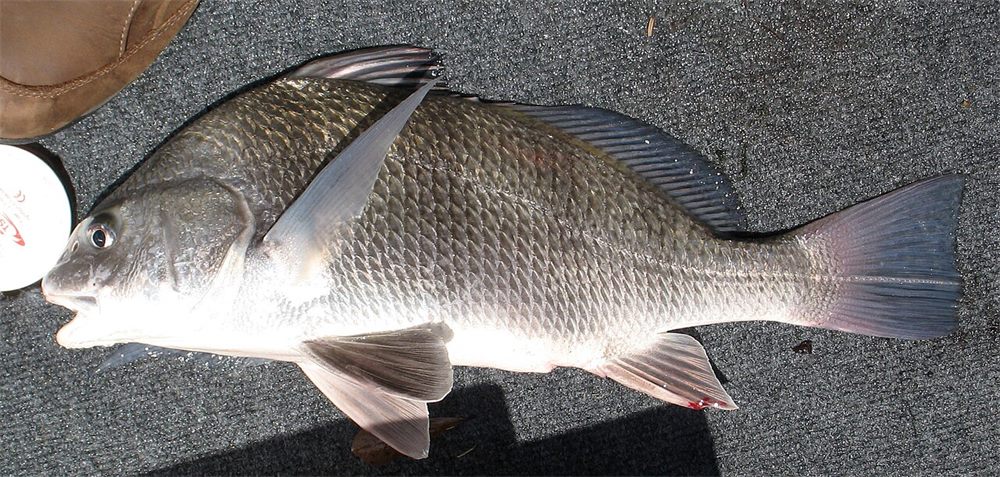
Black drum are heavy-bodied fish with a high, arched back. They are gray to black, fading to a lighter belly, with large scales. Short barbels hang under the chin, and the drum uses them to feel for food. Young fish wear four to six dark vertical bars that fade with age. Strong teeth in the throat crush clams, oysters and crabs.
Black drum are the largest of the drums, but they grow slowly. They reach about 11 to 14 inches in their first year and 19 to 21 inches by age three. The species can top 100 pounds. Florida's record is 96 pounds.
Two look-alikes have different rules. Check the chin first:
- Redfish: no barbels, and usually a black spot near the tail.
- Sheepshead: no barbels, a mouth of incisor teeth, and narrower dark bars.
Season dates
When black drum may be kept, inshore and offshore.
Open all year.
Limits and rules
Bag, size and vessel limits, and what else to know before you keep one.
5 per person per day; 14-24 in. total length slot, but 1 of the 5 may be over 24 in.
Legal gear: hook and line, cast net, seine, spear or gig. No treble or other multi-point hooks with natural bait.
How to catch them
Tackle, baits and how to fish for black drum, and how to release one well.
Drum find food by feel along the bottom, so keep your bait down and close to the pilings of bridges and piers. Shrimp, cut bait, sand fleas, clams and pieces of blue crab all work. Pick tackle to suit the size of the fish and the current. Spinning or baitcasting gear with 15- to 30-pound line covers most spots. Don't be surprised by a deep drumming sound when you land one.
For release:
- Use a non-offset circle hook with natural bait.
- Unhook the fish in the water with wet hands when you can.
- If you lift a big drum, support its weight level with both hands. Never hold it by the gills.
- Cut the line if the hook is deep, and release the fish head first.
Where and when
With the waters we cover where black drum turn up, and their best months.
Black drum feed on the bottom in bays, river mouths and lagoons, over sand and sandy mud. Look around oyster bars, docks, piers, seawalls and bridge pilings. In Tampa Bay, young drum grow up in rivers and tidal creeks with muddy bottoms, then spread across the bay as they grow. Some adults move out to nearshore Gulf waters.
They spawn in winter and early spring. In Tampa Bay that means the lower bay and nearshore Gulf from November through May, mostly in March. Around Tampa Bay the best fishing runs from fall through spring, in the cooler months.
- Sarasota inshoreBest Nov–Apr
- Tampa Bay inshoreBest Nov–Apr
About black drum: from myfwc.com, myfwc.com, myfwc.com, myfwc.com, aquila.usm.edu, myfwc.com, myfwc.com, myfwc.com, gis.myfwc.com and flseagrant.org. Written by H2O Cowboy; updated October 13, 2026.