Can you keep one today?
Rules as of October 11, 2026. Seasons open and close at midnight, Florida time.
- Gulf state watersOpen to keepall year
How to spot one
Centropristis striata
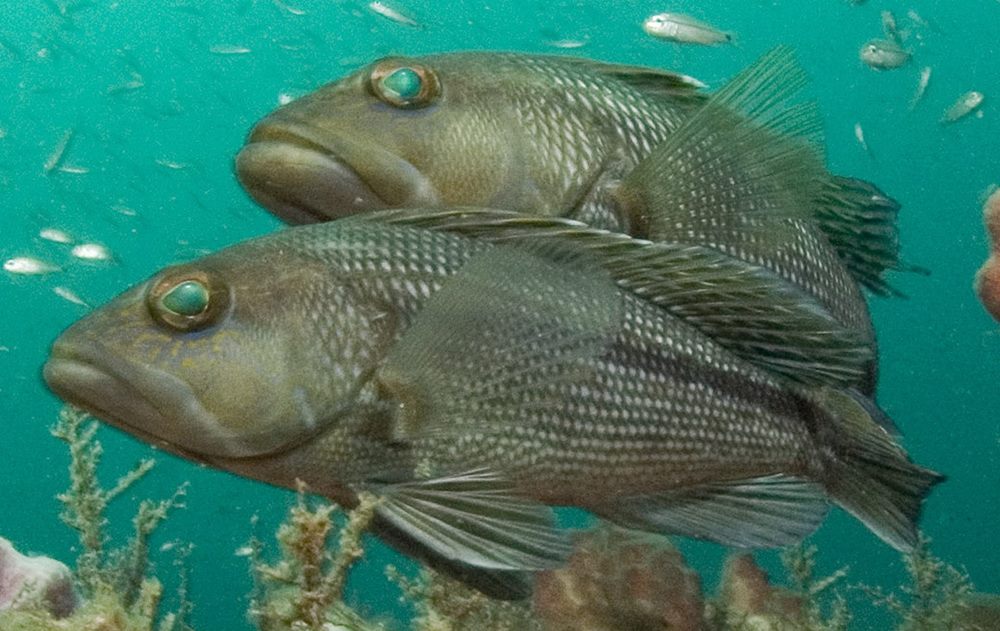
Black sea bass are stout fish, black to dusky brown, with a belly only a little paler than the sides. The dorsal fin carries rows of white spots and bands. Large males grow a fatty hump in front of the dorsal fin, and at spawning time dominant males turn bright blue. Females may show faint vertical bars. Adults often trail a long filament from the top of the tail. Most are about a foot long.
Two relatives share the same bottom:
- Bank sea bass: pale olive or brassy-brown with bars of black blotches, wavy blue lines on the head and purplish-blue lips.
- Rock sea bass: olive-bronze with dark bars and a dark spot near the middle of the dorsal fin base.
Season dates
When black sea bass may be kept.
Open all year.
Limits and rules
Bag, size and vessel limits, and what else to know before you keep one.
100 lb per person, 10 in. total length
How to catch them
Tackle, baits and how to fish for black sea bass, and how to release one well.
Anglers often catch black sea bass by accident while bottom fishing for grouper and snapper. They are aggressive and fun on light tackle, and light to medium spinning or baitcasting gear with 10- to 20-pound line is plenty. Squid, shrimp, cut bait and jigs all work. In winter they can grab the sinker and hang on all the way up.
Sea bass count as reef fish. When you fish for reef fish from a boat, you must use non-stainless steel circle hooks with natural bait (non-offset in state waters) and carry a dehooking tool. In Florida state waters you must also have a descending device or venting tool rigged and ready, and use one on any fish you release that shows barotrauma: a stomach pushed out of the mouth, bulging eyes, or floating. A descending device needs at least a 16-ounce weight and 60 feet of line; for bigger fish, use about a pound of weight for every five pounds of fish. The federal rule requiring one lapsed in January 2026 and a new one has been proposed, but sending a fish back down is still the best way to release it from deep water. To vent instead, slide a hollow tool under a scale two to three inches behind the base of the pectoral fin, at 45 degrees, and pull it out when the hissing stops. Never pierce a protruding stomach.
Where and when
With the waters we cover where black sea bass turn up, and their best months.
Black sea bass need rocks or reefs with holes and crevices, in the bays and the Gulf. Adults prefer 20 to 80 feet, while young ones use seagrass near jetties and reefs. The larger fish usually come from the Gulf, though inshore artificial reefs hold them too. Anglers catch them most often along Florida's central and northern coasts, and they spawn from January through March.
- Tampa Bay nearshoreBest Oct–Apr
About black sea bass: from myfwc.com, myfwc.com, myfwc.com, fisheries.noaa.gov, flseagrant.org, myfwc.com, myfwc.com and myfwc.com. Written by H2O Cowboy; updated October 13, 2026.