Can you keep one today?
Rules as of October 11, 2026. Seasons open and close at midnight, Florida time.
- Gulf state and federal watersInshore and offshoreOpen to keepall year
How to spot one
Trachinotus carolinus
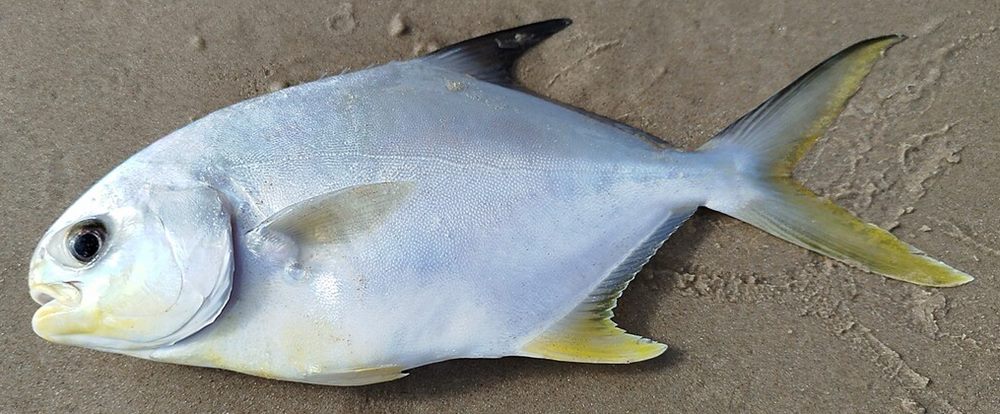
Florida pompano are deep, flat, silvery fish with a darker greenish-gray back. They have a short, blunt snout and a small mouth with rubbery lips. Many show yellow on the throat, belly and lower fins. The dorsal and anal fins are short and upright, and the tail has a wide fork. Most weigh 1 to 2 pounds, and few pass 8 pounds.
Young permit look almost the same and have different rules. Check:
- Dorsal fin: on a pompano it starts ahead of the anal fin. On a permit it starts right above it.
- Soft fin rays: pompano have 22 to 27 in the dorsal fin and 20 to 23 in the anal fin. Permit have 17 to 21 and 16 to 19.
- Tongue: small permit have teeth on the tongue. Pompano never do.
- Head: a pompano's forehead slopes gently. A permit's rises to a hump.
Color alone won't settle it. Permit often show orange, but some show yellow too.
Season dates
When Florida pompano may be kept, inshore and offshore.
Open all year.
Limits and rules
Bag, size and vessel limits, and what else to know before you keep one.
6 per person per day; 11 in. minimum fork length
Gear: hook and line, cast net, beach or haul seine only. No treble or other multi-point hooks with natural bait.
How to catch them
Tackle, baits and how to fish for Florida pompano, and how to release one well.
Most pompano are caught from the beach. A long surf rod helps you reach them, and a pyramid or sputnik sinker holds the bait in the sand. Sand fleas are the top bait. You can rake your own from the wet sand where the waves wash up. Shrimp and fiddler crabs also work, as do small jigs bounced slowly along the bottom.
Small permit often school with pompano along the beaches, so check every fish before you keep it. For fish you release, use a circle hook with natural bait, wet your hands, and get the fish back in the water quickly.
Where and when
With the waters we cover where Florida pompano turn up, and their best months.
Pompano feed along sandy beaches, around passes, and over oyster bars and grass beds, often in murky water. They dig coquina clams and sand fleas out of the surf zone. Some range far up the bays, and others turn up as deep as 130 feet. They follow the tide each day and the water temperature through the year, moving north and south with the 59°F (15°C) mark in nearshore water. In Tampa Bay, adults eat mainly mussels and shrimp.
Spawning happens offshore and peaks in spring and fall, the same seasons that bring pompano runs along the beaches. The best season runs from winter through spring around Tampa Bay, and from fall through spring around Manatee and Sarasota.
- Sarasota inshoreBest Mar–May and Oct–Nov
- Sarasota nearshoreBest Mar–May and Oct–Dec
- Tampa Bay inshoreBest Mar–May and Oct–Dec
- Tampa Bay nearshoreBest Feb–May and Oct–Dec
About Florida pompano: from myfwc.com, myfwc.com, myfwc.com, myfwc.com, myfwc.com, myfwc.com, myfwc.com, gis.myfwc.com, gis.myfwc.com, blogs.ifas.ufl.edu and flseagrant.org. Written by H2O Cowboy; updated October 13, 2026.