Can you keep one today?
Rules as of October 11, 2026. Seasons open and close at midnight, Florida time.
- Gulf state and federal watersInshore and offshoreClosedreopens Dec 1Opens in 4 days
How to spot one
Paralichthys lethostigma, Paralichthys albigutta
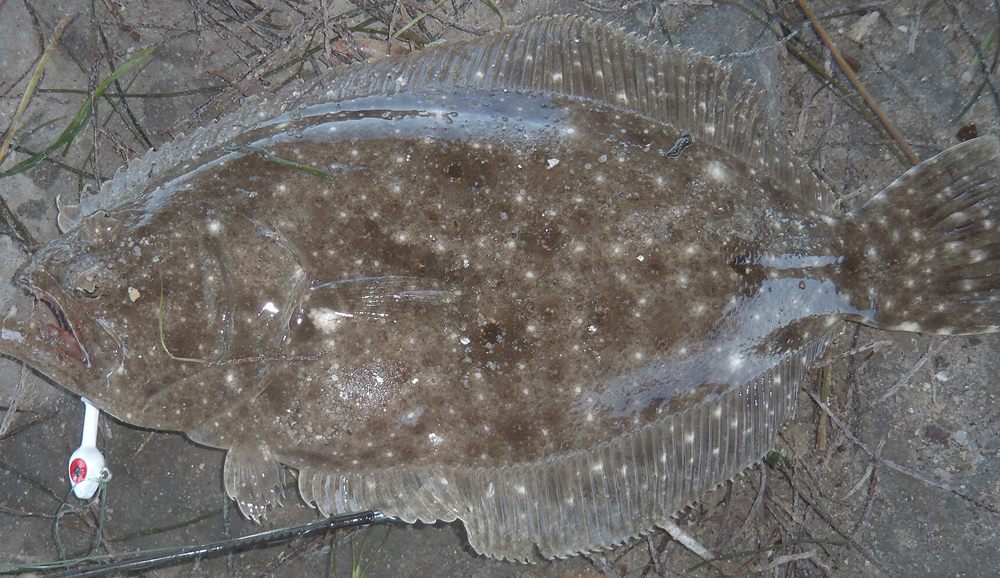
Flounder are flatfish that lie on the bottom with both eyes on the left side of the head. The upper side is mottled with spots and blotches, and the fish can change color to match the bottom. They have large, sharp teeth and a tail that comes to a point in the middle.
Two species are common here:
- Gulf flounder: three distinct eyespots in a triangle, one on the lateral line, one above it and one below. Commonly up to about 14 inches and 2 pounds, and the most common flounder in Southwest Florida.
- Southern flounder: dark spots and blotches but no true eyespots. Grows larger, commonly to about 20 inches.
Summer flounder, with five or more eyespots, turn up mainly in northeast Florida. You don't need to tell them apart for the rules. The flounder rules treat Gulf, southern, summer and fringed flounder alike.
Season dates
When flounder may be kept, inshore and offshore.
Open all year except Oct 15–Nov 30, every year.
Limits and rules
Bag, size and vessel limits, and what else to know before you keep one.
5 per person per day; 14 in. minimum total length
Closed every year Oct 15-Nov 30. Covers Gulf, southern, summer and fringed flounder. Spears and gigs are legal.
How to catch them
Tackle, baits and how to fish for flounder, and how to release one well.
Flounder lie still, often buried in sand up to the eyes, and chase down passing fish and shrimp. Keep your bait within a few feet of the bottom. Live shrimp and small baitfish work well, and so do jigs and spoons. On the flats, fish the incoming tide, a few hours before high water.
Hook and line, gigs, spears, cast nets and seines are all legal gear. You can't keep a flounder caught on a multiple hook, such as a treble, fished with natural bait, and snatching is banned.
To release one, unhook it in the water with wet hands, or cut the line if the hook is deep.
Where and when
With the waters we cover where flounder turn up, and their best months.
Gulf flounder live along the whole Florida coast. Southern flounder range down the Gulf side to about the Caloosahatchee River, so both occur around Tampa Bay and Sarasota. Southern flounder favor silt and mud and push into brackish bays, tidal creeks and fresh water. Gulf flounder favor sand, from the bays out to about 60 feet in the Gulf, and some turn up on nearshore rocky reefs.
Around Tampa Bay, Gulf flounder spend spring and summer near the grass flats in the bays, then move into the Gulf in fall. They bunch up in fall and move offshore to spawn in late fall and winter, in about 65 to 200 feet of water. The best flounder fishing around Tampa Bay and Sarasota runs from fall through spring. Harvest is closed for part of that time, so check today's status at the top of this page before you keep one.
- Sarasota inshoreBest Mar–Jun and Sep–Nov
- Tampa Bay inshoreBest Mar–Oct
- Tampa Bay nearshoreBest Nov–Jan
About flounder: from myfwc.com, myfwc.com, myfwc.com, myfwc.com, myfwc.com, myfwc.com, myfwc.com, myfwc.com, gis.myfwc.com and flseagrant.org. Written by H2O Cowboy; updated October 13, 2026.