Can you keep one today?
Rules as of October 11, 2026. Seasons open and close at midnight, Florida time.
- Gulf state watersCatch and release only
- Gulf federal watersPast 9 nautical milesCatch and release only
How to spot one
Epinephelus itajara
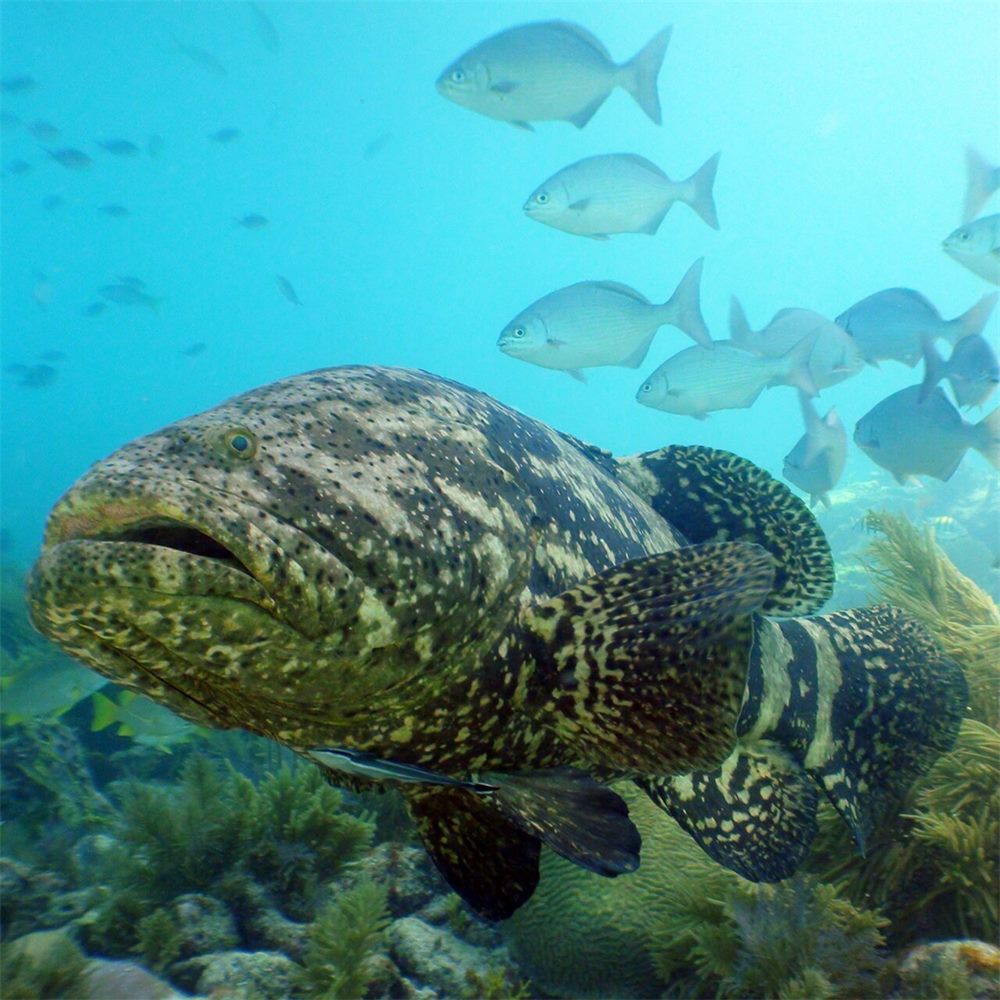
Goliath are the largest groupers in the western Atlantic, reaching 8 feet and 800 pounds. Young fish show yellow-green blotches or bands. Older fish fade to pale brown and grow football-shaped. Tiny dark spots cover the head and fins, and irregular dark bars mark the sides. The eyes are small and set forward. The rounded tail sets goliath apart from other groupers. The spiny dorsal fin is low, with spines of nearly equal height.
Warsaw grouper are the main look-alike, and they have different rules. A Warsaw's second dorsal spine stands far taller than the rest, its tail is squared off, and its body is a plain, mottled reddish-brown or brownish-gray. Adults live over rock deeper than 200 feet.
Season dates
When goliath grouper may be kept, inshore and offshore.
Gulf state waters and Gulf federal waters
Catch and release only: none may be kept.
Limits and rules
Bag, size and vessel limits, and what else to know before you keep one.
Gulf state waters
Catch and release only; release immediately and keep large fish in the water
Only lottery permit + tag holders: 1 fish, 24-36 in. total length, Mar 1-May 31, state waters. Apply Oct 1-15.
Gulf federal waters
Harvest and possession prohibited in Gulf federal waters
Release at once without removing from the water. Circle hooks with natural bait and a dehooker are required.
How to catch them
Tackle, baits and how to fish for goliath grouper, and how to release one well.
Goliath are protected. In Florida waters, only anglers with a special state harvest permit and tag may keep one, and federal waters are closed to harvest and possession. Anyone else must release a goliath right away, alive and unharmed.
To release one safely:
- Large goliath must stay in the water. Their skeletons can't carry their weight in air, and lifting one aboard can cause fatal injuries.
- Keep smaller ones in the water too while you remove the hook.
- Back the hook out with a dehooking tool. If it's deep, cut the leader as close to the hook as you can.
- Take photos only if they don't slow the release, and never hold or tow the fish anywhere to weigh or measure it.
- If it shows barotrauma, such as bulging eyes or a stomach in its mouth, help it back down with a descending device or venting tool.
Where and when
With the waters we cover where goliath grouper turn up, and their best months.
Goliath live near structure in coastal and nearshore water, and over muddy bottom. Young fish spend up to five or six years in estuaries and mangroves, often near bridges, docks and artificial reefs. Adults favor ledges, overhangs, bridges, piers and shipwrecks, and they seldom live deeper than 100 to 150 feet. They are more common in south Florida. They gather to spawn at wrecks, ledges and patch reefs, mostly from July through September. Calico crabs make up most of their diet, but now and then they grab a fish struggling on a line.
- Tampa Bay nearshoreBest Apr–Oct
About goliath grouper: from myfwc.com, myfwc.com, myfwc.com, gulfcouncil.org, flseagrant.org, myfwc.com, myfwc.com and myfwc.com. Written by H2O Cowboy; updated October 13, 2026.