Can you keep one today?
Rules as of October 11, 2026. Seasons open and close at midnight, Florida time.
- Gulf state watersOpen to keepall year
- Gulf federal watersPast 9 nautical milesOpen to keepall year
How to spot one
Euthynnus alletteratus
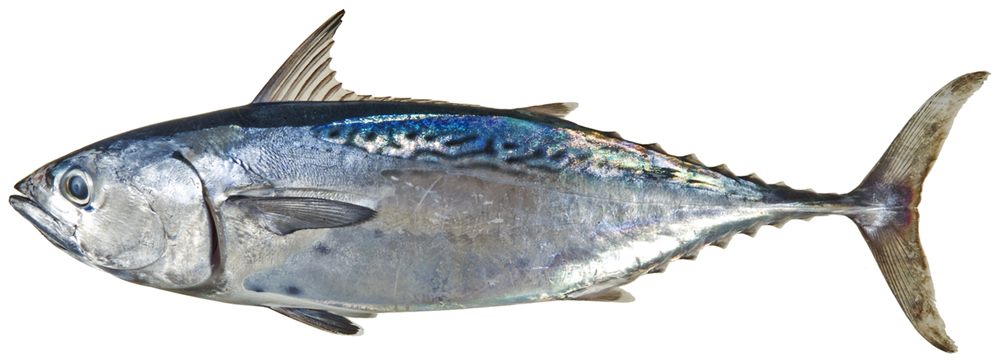
Little tunny, called bonito or false albacore on this coast, are football-shaped tunas with a steel-blue to greenish back and a white or silver belly. Three marks identify them:
- Broken, wavy dark lines on the back, above the lateral line only.
- Three to seven dark spots below the pectoral fin.
- Short pectoral fins and no stripes on the belly.
Most weigh 5 to 10 pounds, and they grow to about 48 inches.
Several look-alikes follow different rules. Blackfin tuna have their own limits. A blackfin has a bronze to golden stripe along each side, dark finlets with white edges, and long pectoral fins that reach back under the second dorsal fin. Skipjack tuna have dark stripes on the lower sides, and fishing for them takes a federal HMS Angling permit, even in state waters. Atlantic bonito have straighter stripes on the back and no spots under the pectoral fin.
Season dates
When little tunny may be kept, inshore and offshore.
Gulf state waters and Gulf federal waters
Open all year.
Limits and rules
Bag, size and vessel limits, and what else to know before you keep one.
Gulf state waters
No size limit; 2 fish or 100 lb per person per day, whichever is more
No species rule; this is FWC's default limit for 'unregulated' fish. No HMS permit needed.
Gulf federal waters
No federal bag or size limit
Not federally managed in the Gulf. Florida's 2-fish/100-lb default may still apply when you land in Florida.
How to catch them
Tackle, baits and how to fish for little tunny, and how to release one well.
Spoons and jigs, cast or trolled, work around feeding fish, and so do lures pulled near reefs. Baits drifted high in the water catch them too. Where there is one, there are usually more, so keep working the same school. Little tunny fight hard for their size.
To keep one for the table, bleed it and ice it right away. The meat is dark red and stronger tasting than that of larger tunas. Many anglers save little tunny for shark bait, since the oily flesh holds a hook well.
To release one, support it with wet hands, unhook it quickly and toss it back head first to get water moving over its gills.
Where and when
With the waters we cover where little tunny turn up, and their best months.
Little tunny are among the most common tunas in Florida waters. They school by size, sometimes in huge numbers, and feed on small fish, squid and crustaceans. They often chase herring and sardines at the surface.
Look for them in open Gulf water deeper than about 20 feet, from the nearshore reefs to offshore water. They range from the surface to the bottom. Little tunny migrate along this coast, moving north in spring and south in fall. Birds diving over bait often give away a feeding school.
- Tampa Bay nearshoreBest Apr–May and Oct–Nov
About little tunny: from myfwc.com, myfwc.com, myfwc.com, myfwc.com, floridamuseum.ufl.edu, floridamuseum.ufl.edu, flseagrant.org, myfwc.com and flseagrant.org. Written by H2O Cowboy; updated October 13, 2026.