Can you keep one today?
Rules as of October 11, 2026. Seasons open and close at midnight, Florida time.
- Gulf state watersOpen to keepall year
- Gulf federal watersPast 9 nautical milesOpen to keepall year
How to spot one
Trachinotus falcatus
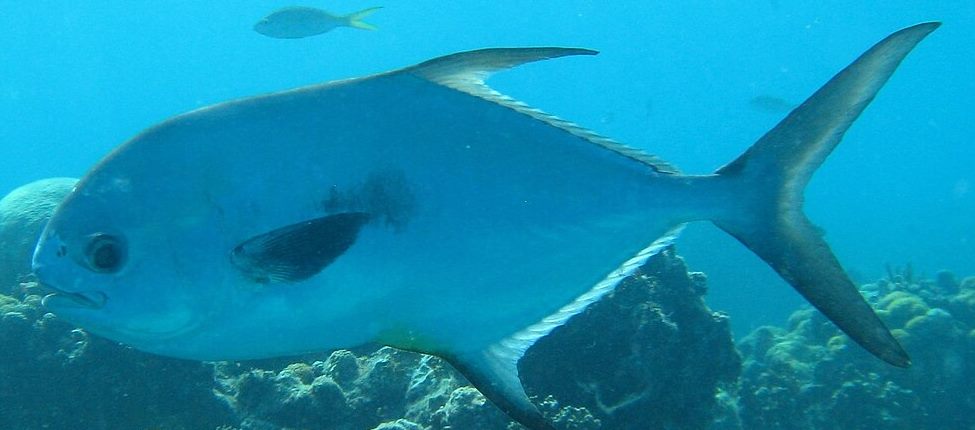
Permit are deep, flat, silver fish with a gray, dark or bluish back and a small mouth. The forehead climbs steeply to a hump. The dorsal, anal and tail fins are long and swept back, with a narrow tail fork. Small permit often show orange on the chin, belly or fins, and some have a black spot behind the pectoral fin.
Permit grow far bigger than pompano. Most caught on Florida's southwest coast weigh under 15 pounds, and some pass 40 pounds.
Young permit and Florida pompano are easy to mix up, and their rules differ:
- Dorsal fin: on a permit it starts right above the anal fin. On a pompano it starts farther forward.
- Soft fin rays: permit have 17 to 21 in the dorsal fin and 16 to 19 in the anal fin. Pompano have 22 to 27 and 20 to 23.
- Tongue: small permit have teeth on the tongue. Pompano never do.
Some permit show yellow like a pompano, so check the fins and tongue.
Season dates
When permit may be kept, inshore and offshore.
Gulf state waters and Gulf federal waters
Open all year.
Limits and rules
Bag, size and vessel limits, and what else to know before you keep one.
Gulf state waters
2 per person per day; 11-22 in. fork length slot, 1 of the 2 may be over 22 in.; max 2 over 22 in. per vessel
Hook and line only. No for-hire captain/crew bag. South Florida's Special Permit Zone rules don't apply here.
Gulf federal waters
2 per person per day; 11-22 in. fork length slot, 1 of the 2 may be over 22 in.; max 2 over 22 in. per vessel
Same limits; spearing is also allowed in federal waters. No for-hire captain/crew bag.
How to catch them
Tackle, baits and how to fish for permit, and how to release one well.
Crabs are the top bait, then shrimp. Permit also take clams and sometimes small fish. For small permit, fish the bottom along beaches or near passes. On Gulf wrecks, hang a crab just under the surface, even over 100 feet of water. Lures can work, though fly fishing rarely does. Permit can strip a lot of line, so use tackle that lands them fast.
For release:
- Use a non-offset circle hook with natural bait.
- Unhook the fish in the water with wet hands.
- Support its weight level if you lift it.
- Revive a tired fish before letting go.
Where and when
With the waters we cover where permit turn up, and their best months.
In northern and central Florida, permit are mainly a warm-season fish. Small permit, under about 3 pounds, often school with pompano along the beaches and around inshore reefs and piers. Adults use channels, deep holes, and sand and grass flats. Schools also hold over Gulf wrecks and reefs out to about 100 feet, sometimes for days.
Statewide, March through June are the most productive months, peaking in April. A second peak runs from November through January, when permit gather in warm water near power plants. Permit spawn over offshore reefs in summer, and some may spawn again in fall in Tampa Bay.
- Sarasota nearshoreBest Apr–Sep
- Tampa Bay nearshoreBest Apr–Sep
About permit: from myfwc.com, myfwc.com, myfwc.com, myfwc.com, myfwc.com, myfwc.com, myfwc.com, gis.myfwc.com and flseagrant.org. Written by H2O Cowboy; updated October 13, 2026.