Can you keep one today?
Rules as of October 11, 2026. Seasons open and close at midnight, Florida time.
- Gulf state and federal watersInshore and offshoreCatch and release only
How to spot one
Megalops atlanticus
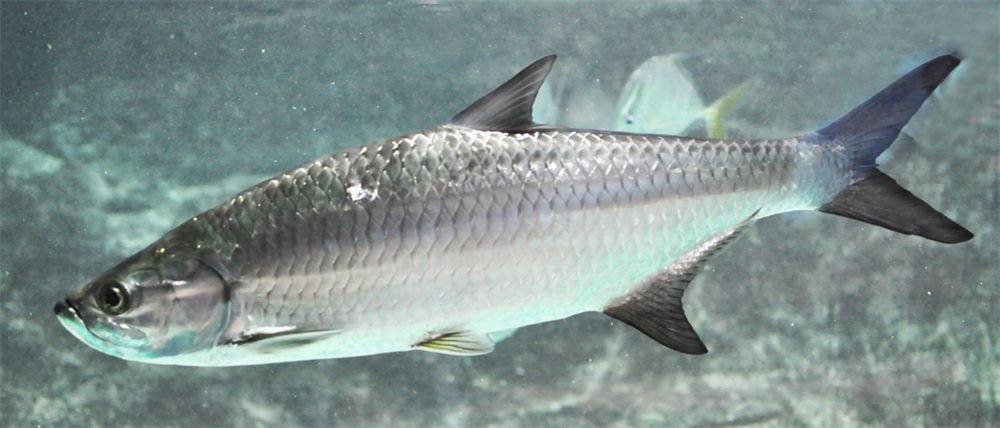
Tarpon are big, bright silver fish with a dark blue-green or greenish-black back. The scales are very large, and the big mouth angles upward with a jutting lower jaw. The single dorsal fin ends in a long, trailing ray. Tarpon often roll at the surface to gulp air. They can grow to 8 feet. Females take about 10 years to mature, at roughly 50 inches fork length.
Young tarpon look like ladyfish. A ladyfish is slimmer, with small scales, a small pointed head and a mouth at the very tip of the snout. Its last dorsal ray has no long thread.
Season dates
When tarpon may be kept, inshore and offshore.
Catch and release only: none may be kept.
Limits and rules
Bag, size and vessel limits, and what else to know before you keep one.
Catch and release only. No size limit; a tarpon over 40 in. fork length must stay in the water.
Exception: 1 tarpon tag per person per year ($51.50), only to pursue a state or world record; 1 per vessel.
How to catch them
Tackle, baits and how to fish for tarpon, and how to release one well.
Tarpon take live and dead bait, flies, plugs and jigs. Use a long, heavy monofilament leader, because the gill plates and tail can cut through a light one. Circle hooks are the better choice.
Tarpon are catch-and-release only. Keeping one requires a tarpon tag and is allowed only when going for a state or world record. The law also requires any tarpon more than 40 inches fork length to stay in the water.
To release one:
- Get a big tarpon alongside within 20 minutes.
- Keep the gills in the water, and never drag the fish over the gunwale, rocks or a railing.
- Unhook it with a long dehooker, or cut the line near the hook.
- Hold a tired fish level in the water until it swims off.
- If sharks show up, land fish faster or move.
About 90 percent of tarpon released in Tampa Bay survive. Avoid fishing for tarpon from bridges and piers, where you can't keep a big fish in the water.
Where and when
With the waters we cover where tarpon turn up, and their best months.
Tarpon live mostly inshore. Around Tampa Bay, look near bridges, pilings, rock walls, harbors and flats. Young tarpon use low-salinity backwaters and often live in fresh water. In winter most adults move to South Florida, though some stay in the peninsula's waters all year.
Tarpon spawn offshore from April through August. Big schools gather in the Gulf passes in May and June, then spread through the area in summer and fall. The best season runs from spring through summer around Tampa Bay, and from spring to early summer around Manatee and Sarasota.
- Sarasota inshoreBest May–Sep
- Sarasota nearshoreBest May–Aug
- Tampa Bay inshoreBest Apr–Sep
- Tampa Bay nearshoreBest May–Sep
About tarpon: from myfwc.com, myfwc.com, myfwc.com, myfwc.com, myfwc.com, myfwc.com, myfwc.com, myfwc.com, gis.myfwc.com, law.cornell.edu and flseagrant.org. Written by H2O Cowboy; updated October 13, 2026.