- Depth
- 1-6 ft
- Access
- By boat or from shore
- Best months
- March to June, September to December
- Species
- Spotted seatrout, Redfish (red drum), Snook, Flounder
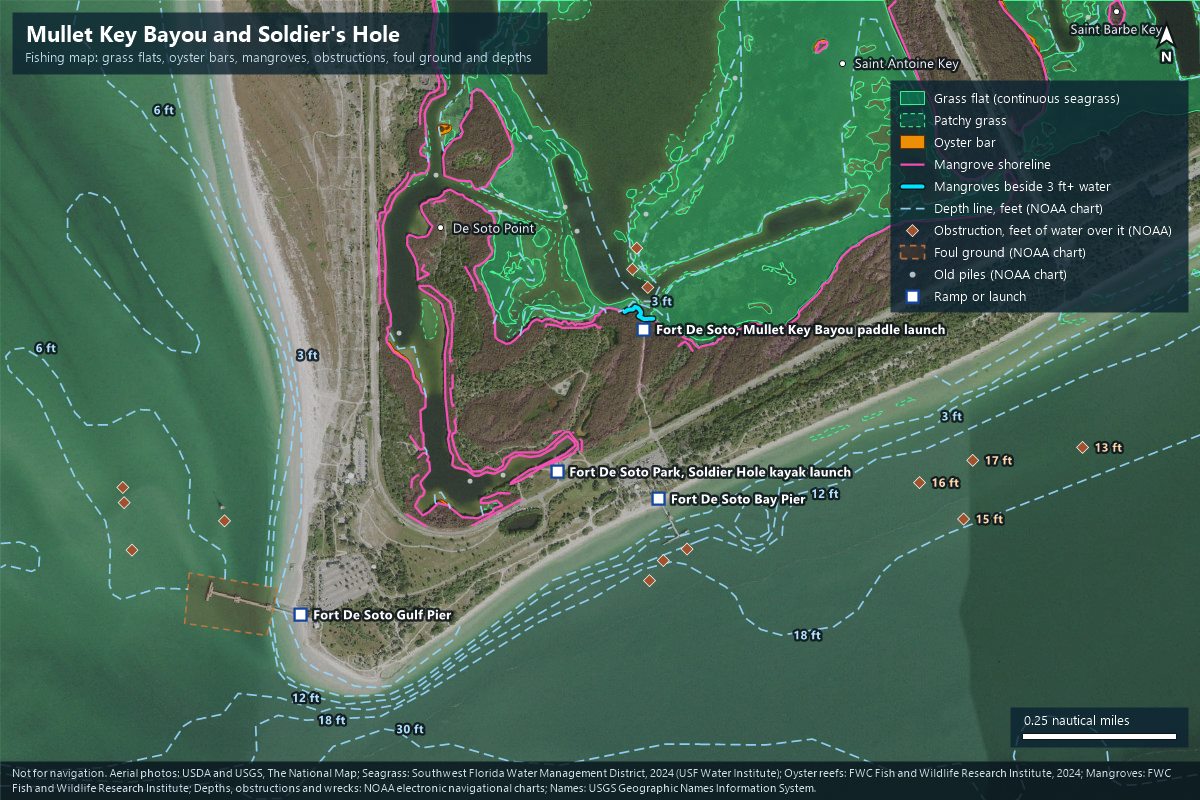
Mullet Key Bayou is the shallow, sheltered water in the middle of Fort De Soto Park. It lies west of the campground and the Pinellas Bayway South, with Anderson Boulevard running along Mullet Key on its south and west sides. Soldier's Hole is the big bend of Mullet Key across from the old fort, where the park's 2.25-mile canoe trail threads along the mangroves and out into the bayou.
It's mostly grass flat, about 1 to 6 feet deep at low tide, edged by mangrove keys and points with oyster beds sticking out from them. During World War II the keys were used for bombing practice, and the bombs blew deep holes in the grass flats around them. The holes have filled in a good deal, but they still show as pale sand potholes in the grass, and the park has posted warnings about wading near the deep ones. A stake-marked channel carrying about 3 feet runs from Bunces Pass to the south end of the bayou, and small boats can anchor inside.
Launch a kayak at Soldier Hole, where the park rents kayaks, or at the Mullet Key Bayou paddle launch; both are hand launches open 7 a.m. to sunset. You can also wade in along the mangrove shoreline of the main park road. Parking is $6 a day.
How to fish it
Trout, redfish and snook all spend part of their lives in these backwaters, and flounder settle into the potholes in season. It fishes from spring into early winter; in summer, go early in the day. Fish the mangrove edges on the high part of the tide, when snook and redfish slip back into the roots to feed and hide.
Polarized sunglasses make the potholes easy to spot as pale sand patches in the grass. Fish spook if you walk right up on a hole, so scout a few on one trip and plan your approach for the next. Work out which way the tide is running, set up to cast up-current of the hole, and let your bait drift in on its own. Trout, redfish and snook lie in the grass along the rim and grab bait that shows up over the sand.
Free-line a live shrimp, pinfish or whitebait. If the grass keeps fouling it, add a small float set just high enough to hold the bait above the grass. Flounder sit on the bottom of the holes: pinch on a small sinker about a foot above the hook, and use whitebait if you can get it, since they take it over shrimp. Light gear is plenty: 8- to 12-pound line, or 10-pound tackle with a 20- to 30-pound leader in case a fish bolts for the mangroves.
With lures, stay above the grass. Topwater plugs, shallow-running plugs, very light jigs of 3/32 ounce or less, and gold spoons all work. Start a spoon moving the moment it lands and keep it just under the surface. Over the deeper grass, a soft-plastic shrimp imitation on a 1/8-ounce jighead also takes trout and small snook.
Along the mangroves, work the points with oysters on them, the cuts and the drop-offs. A gold spoon covers water fastest; once you find fish, switch to live bait if you like. From a kayak, carry two or three rigged rods so you aren't retying: a topwater plug for snook along the roots, a soft-plastic jig for trout over the grass, and a gold spoon for redfish on the oyster bars.
Look the area over at low tide first so you know where the holes, bars and snags are, then come back on the higher water and work the deeper holes and the channel edges, where fish wait for bait. Handle fish you release with wet hands, keep them in the water when you can, and let them go head first.