Can you keep one today?
Rules as of October 11, 2026. Seasons open and close at midnight, Florida time.
- Gulf state and federal watersInshore and offshoreOpen to keepall year
How to spot one
Thunnus atlanticus
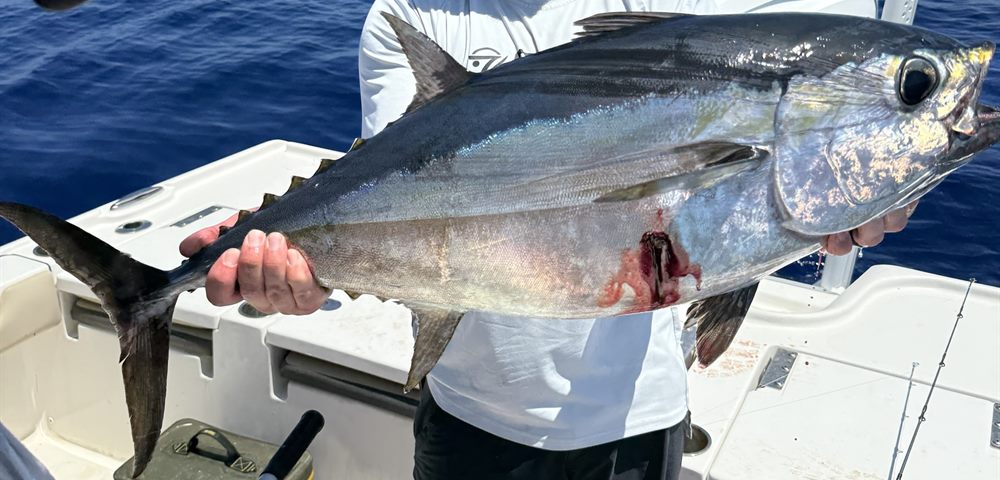
Blackfin tuna have a bluish-black back, gray to silver sides and a white belly. A bronze to golden stripe runs along each side, though it fades after death. The finlets behind the second dorsal fin are dark with white edges and show no yellow. The pectoral fins reach back to below the start of the second dorsal fin. Most are under 30 inches; the largest reach about 39 inches and 46 pounds.
Look-alikes follow different rules, so check more than one mark:
- Little tunny have broken, wavy dark lines on the back and dark spots under short pectoral fins.
- Yellowfin tuna: big ones grow long second dorsal and anal fins, but small ones don't. On a small or dead tuna, look at the finlets on the underside near the tail: yellow on a yellowfin, silvery or dark on a blackfin. Yellowfin also have pale lines and dots on the belly. Fishing for yellowfin takes a federal HMS Angling permit, even in state waters.
- Skipjack tuna have dark stripes on the lower sides and need the same permit.
Season dates
When blackfin tuna may be kept, inshore and offshore.
Open all year.
Limits and rules
Bag, size and vessel limits, and what else to know before you keep one.
2 per person or 10 per vessel, whichever is greater; no size limit
FWC rule also covers adjacent federal waters. Not a federally managed tuna; no HMS permit needed.
How to catch them
Tackle, baits and how to fish for blackfin tuna, and how to release one well.
Anglers take blackfin by trolling and by drift fishing. Work baits and lures near the surface when fish feed there. Blackfin fight hard, so use tackle heavy enough to land them quickly.
For a fish you will release, bring it alongside fast and keep it in the water. Use a dehooker, and never lift it by the gills or eyes. A gentle head-first toss back into the water can help a tired tuna recover. Blackfin are excellent eating if you keep one.
Where and when
With the waters we cover where blackfin tuna turn up, and their best months.
Blackfin are open-ocean fish of warm, clean water, found mostly past the edge of the continental shelf. That edge lies much farther from land off Florida's west coast than off Pensacola or Destin. From Tampa Bay or Sarasota, finding blackfin means a long run. They school, frequently with skipjack, and often feed near the surface.
Fall through spring is peak blackfin time off Florida. In the Panhandle, where deep water is closer, the best fishing runs from late summer into early winter. Offshore, look for diving birds and surface feeding, floating debris and sargassum, current edges, color changes and temperature breaks.
- Sarasota offshoreBest Mar–May and Oct–Nov
- Tampa Bay offshoreBest Oct–Apr
About blackfin tuna: from myfwc.com, myfwc.com, myfwc.com, myfwc.com, floridamuseum.ufl.edu, myfwc.com, myfwc.com, blogs.ifas.ufl.edu, myfwc.com and flseagrant.org. Written by H2O Cowboy; updated October 13, 2026.