Can you keep one today?
Rules as of October 11, 2026. Seasons open and close at midnight, Florida time.
- Gulf state watersOpen to keepthrough Dec 3135 days left
- Gulf federal watersPast 9 nautical milesOpen to keepthrough Dec 3135 days left
How to spot one
Balistes capriscus
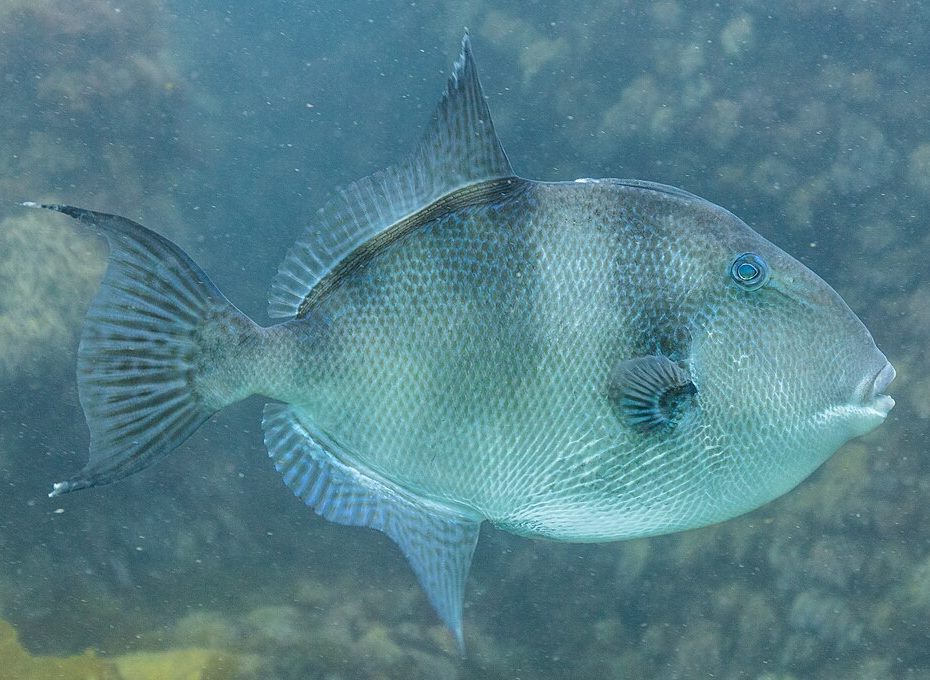
Gray triggerfish are flat, oval fish with tough, plate-like scales and sandpapery skin. Adults are olive-gray, with blue spots and lines on the upper body and dorsal fin and a blue rim over the eye. The dorsal and anal fins look marbled. The small mouth holds chisel-like teeth for crushing shells.
The first dorsal spine is a stout spike that locks upright. Press down the small second spine, the trigger, to unlock the first. Large adults grow long points on the top and bottom of the tail. Young fish have big dark spots on the back. Typical catches weigh 2 to 4 pounds, and the Florida record is 12 pounds 7 ounces.
Season dates
When gray triggerfish may be kept, inshore and offshore.
Gulf state waters and Gulf federal waters
Open all year except January–February and June–July, every year.
Limits and rules
Bag, size and vessel limits, and what else to know before you keep one.
Gulf state waters
1 per person, 15 in. fork length
Closed Jan 1-end of Feb and Jun 1-Jul 31. State Reef Fish Angler designation needed.
Gulf federal waters
1 per person within the 20-fish reef fish aggregate, 15 in. fork length
Closed Jan-Feb & Jun-Jul; may close early on quota. State Reef Fish Angler designation needed.
How to catch them
Tackle, baits and how to fish for gray triggerfish, and how to release one well.
Triggerfish steal a lot of bait. Their hard, bony mouths call for a small, very sharp hook. Whole or cut shrimp is a favorite bait, and squid or cut fish work too. A small jig bounced along the bottom sometimes works. Light to medium bottom tackle with 20- to 50-pound line is enough. Keep fingers clear of the teeth when you unhook one.
When you fish for reef fish from a boat, you must use non-stainless steel circle hooks with natural bait (non-offset in state waters) and carry a dehooking tool. In Florida state waters you must also have a descending device or venting tool rigged and ready, and use one on any fish you release that shows barotrauma: a stomach pushed out of the mouth, bulging eyes, or floating. A descending device needs at least a 16-ounce weight and 60 feet of line; for bigger fish, use about a pound of weight for every five pounds of fish. The federal rule requiring one lapsed in January 2026 and a new one has been proposed, but sending a fish back down is still the best way to release it from deep water. To vent instead, slide a hollow tool under a scale two to three inches behind the base of the pectoral fin, at 45 degrees, and pull it out when the hissing stops. Never pierce a protruding stomach.
Where and when
With the waters we cover where gray triggerfish turn up, and their best months.
Adults live over hard bottom, reefs, ledges and artificial reefs, mostly from 80 to 300 feet, alone or in small groups. They share that habitat with red snapper and often come up alongside them. Anglers seldom catch them in the bays. Gray triggerfish spawn from April to August. Males dig nests in the sand, and females guard and fan the eggs. The young spend months drifting with floating sargassum before settling to the bottom.
- Sarasota offshoreBest all year
- Tampa Bay offshoreBest all year
About gray triggerfish: from myfwc.com, fisheries.noaa.gov, flseagrant.org, myfwc.com, myfwc.com and myfwc.com. Written by H2O Cowboy; updated October 13, 2026.