Can you keep one today?
Rules as of October 11, 2026. Seasons open and close at midnight, Florida time.
- Gulf state watersClosedno reopening date set yet
- Gulf federal watersPast 9 nautical milesClosedno reopening date set yet
How to spot one
Seriola dumerili
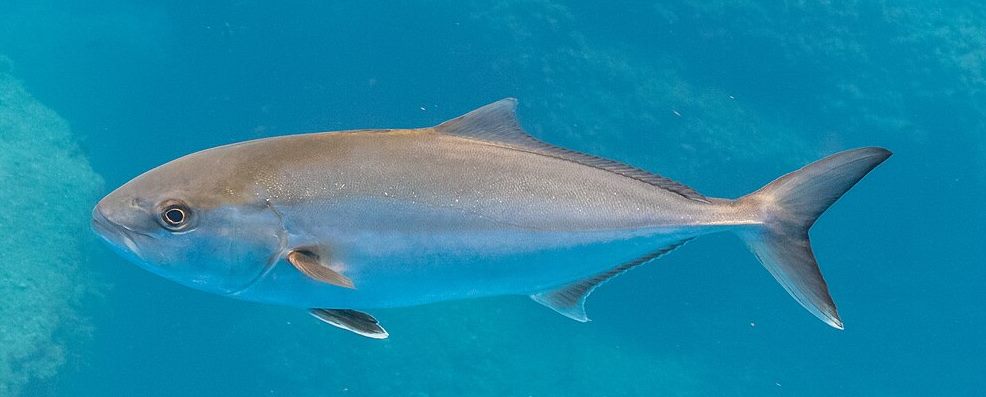
Greater amberjack are the largest jacks, with a long, torpedo-shaped body. The back is olive, brown or bluish-gray and the sides silvery. A dark amber band runs from the snout through the eye to the first dorsal fin, darkening when the fish feeds. Most are around 40 inches and under 40 pounds.
Three cousins have different rules:
- Lesser amberjack: the band stops at the eye, the eye looks large, and the first dorsal fin has 8 spines. A greater's band reaches the snout, and it has 7 spines.
- Almaco jack: a deeper, flatter body with tall, long front lobes on the second dorsal and anal fins.
- Banded rudderfish: slimmer and paler, with no dark eye band as adults, white tail tips, and an anal fin half as long as the second dorsal.
Season dates
When greater amberjack may be kept, inshore and offshore.
Gulf state waters and Gulf federal waters
Open Sep 1–Oct 13, 2026. Dates after August 31, 2027 aren't set yet.
Limits and rules
Bag, size and vessel limits, and what else to know before you keep one.
Gulf state waters
1 per person, 34 in. fork length
Closes 12:01 a.m. Oct 14, 2026; closed through Aug 31, 2027. State Reef Fish Angler designation needed.
Gulf federal waters
1 per person, 34 in. fork length; for-hire captain & crew: 0
Closes 12:01 a.m. Oct 14, 2026; closed through Aug 31, 2027. State Reef Fish Angler designation needed.
What changed lately
- FWC set the season to close at 12:01 a.m. Oct 14, the same as federal waters (Executive Order 26-25). Both stay closed through Aug 31, 2027.
How to catch them
Tackle, baits and how to fish for greater amberjack, and how to release one well.
Tackle of 50 to 100 pounds is typical, though lighter gear often works. Almost any lively baitfish works: blue runners, pinfish, grunts or cigar minnows. Amberjack swim above the reef, so add just enough lead to hold the bait mid-water, and try several depths. Fired-up fish rise to topwater plugs, jigs, spoons and diving lures. Set the drag before the drop: they pull hard and keep pulling.
When you fish for reef fish from a boat, you must use non-stainless steel circle hooks with natural bait (non-offset in state waters) and carry a dehooking tool. In Florida state waters you must also have a descending device or venting tool rigged and ready, and use one on any fish you release that shows barotrauma: a stomach pushed out of the mouth, bulging eyes, or floating. A descending device needs at least a 16-ounce weight and 60 feet of line; for bigger fish, use about a pound of weight for every five pounds of fish. The federal rule requiring one lapsed in January 2026 and a new one has been proposed, but sending a fish back down is still the best way to release it from deep water. To vent instead, slide a hollow tool under a scale two to three inches behind the base of the pectoral fin, at 45 degrees, and pull it out when the hissing stops. Never pierce a protruding stomach.
Where and when
With the waters we cover where greater amberjack turn up, and their best months.
Adults hang around rocky reefs, rock outcrops, wrecks and debris offshore, typically in 60 to 240 feet. Anglers catch most of them on Gulf wrecks. Young fish school, and the oldest fish tend to live alone. Juveniles live under floating sargassum before settling to the bottom. Greater amberjack spawn mainly from March to June on reefs and wrecks.
- Sarasota offshoreBest all year
- Tampa Bay offshoreBest all year
About greater amberjack: from myfwc.com, myfwc.com, myfwc.com, fisheries.noaa.gov, floridamuseum.ufl.edu, gulfcouncil.org, flseagrant.org, myfwc.com, myfwc.com and myfwc.com. Written by H2O Cowboy; updated October 13, 2026.