- Depth
- 1-16 ft
- Access
- By boat
- Best months
- All year
- Species
- Tarpon, Snook, Sheepshead, Mangrove (gray) snapper
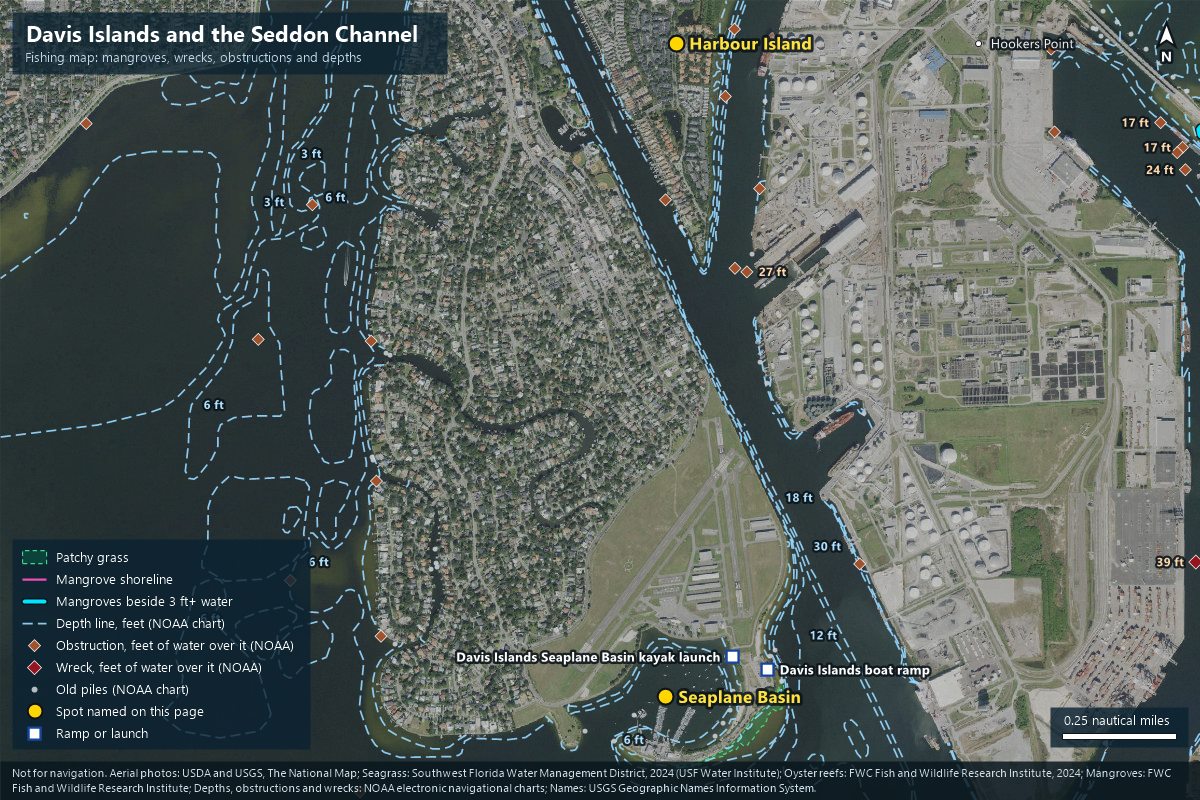
Davis Islands sit at the mouth of the Hillsborough River, just south of downtown Tampa, with Tampa General Hospital on the north tip and Peter O. Knight Airport and the Seaplane Basin at the south end. The Seddon Channel runs up the islands' northeast side, between Davis Islands and Harbour Island, to the turning basin at the river mouth. The main ship channel into the port runs along the islands' east side, and the west side faces Bayshore Boulevard across about a mile of open bay.
The Seddon Channel's federal project depth is 12 feet, and the chart shows about 6 to 16 feet in it. Marjorie Park's city yacht basin, on the west side of the channel, is about 7 feet deep and sells fuel. At the north end, two fixed bridges about 100 yards apart link the islands to the mainland, and only small boats fit under them between the Seddon Channel and the bay along Bayshore: the north bridge clears less than 10 feet at high tide and the south bridge about 13 feet, and the narrowest opening is about 34 feet wide. The water on the west side runs from about 1 foot near shore to about 15 feet on the chart.
The City of Tampa's boat ramp is on the islands' southeast shore at 864 Severn Avenue: no fee, open 24 hours. Repairs had it only partly open in 2025, with work expected to run through 2026. A hand launch for kayaks sits just to the west, inside the Seaplane Basin, where the city plans to replace failing docks and add a mooring field. The basin also has a city swimming beach. NOAA predicts tides at Davis Island (station 8726657).
How to fish it
Plan to fish Davis Islands from a boat or kayak. The parks on the islands are city parks, where fishing from shore, ramps or docks is allowed only in spots the city designates. The Seaplane Basin beach is a swimming beach with boats barred from its swim area, and wading within 200 feet of a boat ramp or in a boat channel is illegal. Fishing isn't allowed along the Bayshore Boulevard trail across the water to the west.
Late summer is tarpon time. From late July through October, schools of big tarpon, many of them 40 to 100 pounds, push into the upper bay, and the water around Davis Islands can hold plenty of them. Free-line a live threadfin or a crab, or fish cut mullet or ladyfish on the bottom and expect catfish to find the dead bait first; on hot days, fish at night. Use stout tackle and a long, heavy leader. Fights are long, so be ready to follow a fish away from seawalls, pilings and channel traffic, but never into a security zone. Tarpon are catch-and-release only: keep any tarpon over 40 inches in the water to unhook it, or cut the leader close to the hook.
Work the seawalls, docks and bridge pilings for snook as you would anywhere in the upper bay, on moving water. At night in the warm months, hold up-current of a lighted dock and pitch a live shrimp to the edge of the light, not into it, or work a chartreuse or red-and-white plug along the shadow line, best in the first two to three hours of the falling tide. In the cold months snook gather along seawalls to stay warm and head up the river. Fish slowly along the walls and the deeper channel edges with a slow-sinking twitchbait or a soft-plastic grub on a light jighead, or a free-lined shrimp on the coldest days. If you spook a group, ease away and try again in half an hour.
Sheepshead and mangrove snapper are caught along the Seddon Channel's seawalls and pilings. From late fall into early spring, drop a fiddler crab, a piece of shrimp or a sand flea on a #1 or 1/0 hook with about a foot of 20-pound fluorocarbon, tight against the structure, and set the hook fast. In the warm months, free-line a small live shrimp on light fluorocarbon for the snapper. Snook are catch-and-release in their closed seasons; check FWC's Tampa Bay snook rules before you keep one. Release fish in the water with wet hands, and revive a tired fish facing into the current until it swims off.