- Access
- By boat or from shore
- Best months
- All year
- Species
- Snook, Tarpon, Spotted seatrout, Crevalle jack, Sheepshead, Sharks
The Hillsborough River is tidal for about 8 miles, from the City of Tampa's dam at Rowlett Park in Sulphur Springs, the head of navigation, down through the city to the turning basin at the top of the Seddon Channel, where it meets the Garrison Channel off downtown. Below the dam the water is brackish and rises and falls with the tide, and the farther downstream you go, the more bay fish you find. The dam holds back the reservoir that supplies most of Tampa's drinking water, so in dry spells little fresh water comes over it. Under a plan adopted in 2007, water from Sulphur Springs and the Blue Sink is added in dry periods to keep the lower river from getting salty enough to stress its fish.
Downtown, the river runs between seawalls past the Riverwalk, Curtis Hixon Park, the University of Tampa, Julian B. Lane Riverfront Park and Water Works Park, with a bridge every few hundred yards from Platt Street at the mouth up to North Boulevard; farther up, Columbus Drive, Martin Luther King Jr. Boulevard, Hillsborough Avenue and Sligh Avenue cross it. Daymarkers mark the channel only a short way past the North Boulevard bridge. Above that the river is narrow and unmarked, running north past Rick's on the River, Rivercrest Park and Lowry Park to Sulphur Springs. The chart shows about 2 to 10 feet near the mouth, and the marked river channel had a controlling depth of only about 3.6 feet in a 2023 survey.
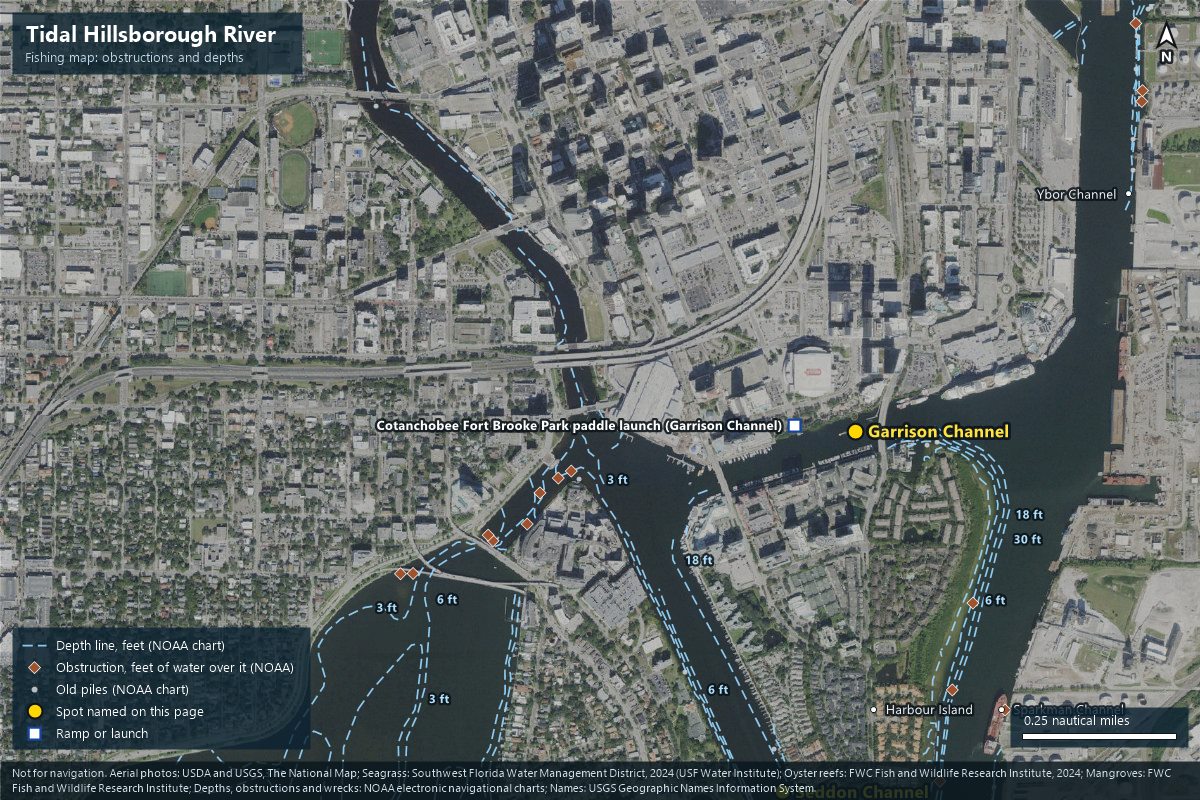
Paddlers can launch at Cotanchobee Fort Brooke Park on the Garrison Channel, Julian B. Lane Riverfront Park (launches by the dog park at its north end), Water Works Park and Rivercrest Park. Julian B. Lane, Water Works and Cotanchobee are open 7 a.m. to 10 p.m. The city's two-lane Lowry Park ramp, across from ZooTampa, has no launch fee and the park has fishing docks; Rick's on the River has a ramp open to the public for a fee. The nearest big ramp is on Davis Islands. NOAA predicts tides at the river entrance (station 8726693) and at West Tampa (8726711).
How to fish it
This is a winter river first. When cold fronts push the bay below the mid-60s, snook turn sluggish and move up the tidal rivers, and the Hillsborough is one of the bay's main winter refuges. Look for them along seawalls, where they gather to stay warm, over muddy bottom, in the deeper bends and holes, around bridge pilings and on the points where the current runs hardest. On the coldest, windiest days, try sandy banks on the northeast shore of coves and canals. Winter snook don't travel far: if you spook a group, ease off and come back in about half an hour.
Fish slowly in cold water. A slow-sinking twitchbait or a soft-plastic grub on a light jighead, crawled along the wall with long pauses, is the classic winter approach. When the water is mild, live pilchards or pinfish work well; on a cold day a shrimp, free-lined or fished on the bottom, often beats livelier bait because the fish won't chase. Speckled trout hold in the deeper bends through the winter; fish a large shrimp or a live bait on the bottom for them.
The biggest snook sit in the deep holes of the river channel and near its mouth. Drift a live sardine into a hole as the tide starts to fall. Moving water is what turns them on: fish the outgoing tide, on days with two highs and two lows; on days with a single, slow tide the bite is weak.
From late spring through fall, fish the bridges and the lighted docks at night. Pitch a live shrimp to the edge of a dock light, or work a plug or a soft plastic along the shadow line under a lit bridge during the first two to three hours of the falling tide. Hold your boat or kayak up-current and let the tide carry the bait to the pilings. Tarpon move up the river in the warm months, and crevalle jacks, ladyfish and sharks come up from the bay too.
From late fall into early spring, sheepshead graze the barnacles on seawalls and bridge pilings. Drop a fiddler crab, a piece of shrimp or a sand flea on a #1 or 1/0 hook with about a foot of 20-pound fluorocarbon and only enough weight to hold bottom, tight against the structure. Keep the line tight and set the hook quickly; sheepshead steal bait.
Medium spinning tackle with a heavier fluorocarbon leader handles most of what you'll hook here; walls, fenders and pilings cut line, so pull fish away from them fast. Tarpon are catch-and-release only, and a tarpon over 40 inches must stay in the water, so don't try for big tarpon from a bridge or a high wall: fish for them from a boat or kayak, and cut the leader close to the hook if you can't unhook one quickly. Snook are catch-and-release in their closed seasons, so check FWC's Tampa Bay snook rules. Unhook every fish you release in the water with wet hands, and hold a tired snook upright, facing into the current, until it swims off.