- Access
- From shore
- Best months
- All year
- Species
- Spanish mackerel, Snook, Tarpon, Cobia, Sheepshead, Gag grouper, Florida pompano, Mangrove (gray) snapper, Crevalle jack, Sharks
The approach spans of the old Sunshine Skyway Bridge, kept as two fishing piers at the mouth of Tampa Bay: the north pier, reached from I-275 on the Pinellas side, and the south pier on the Manatee side. After the new bridge opened in 1987, the old bridge's center spans were taken down in 1991 and 1992 and the rest was kept for fishing; the state made the piers Skyway Fishing Pier State Park in 1994. You fish from the western spans; the eastern spans beside them closed in August 2008, and many of their sections were torn down in 2011 and 2012. You drive out and park next to your spot, the piers are open 24 hours a day all year, and the lights along them draw bait and fish after dark.
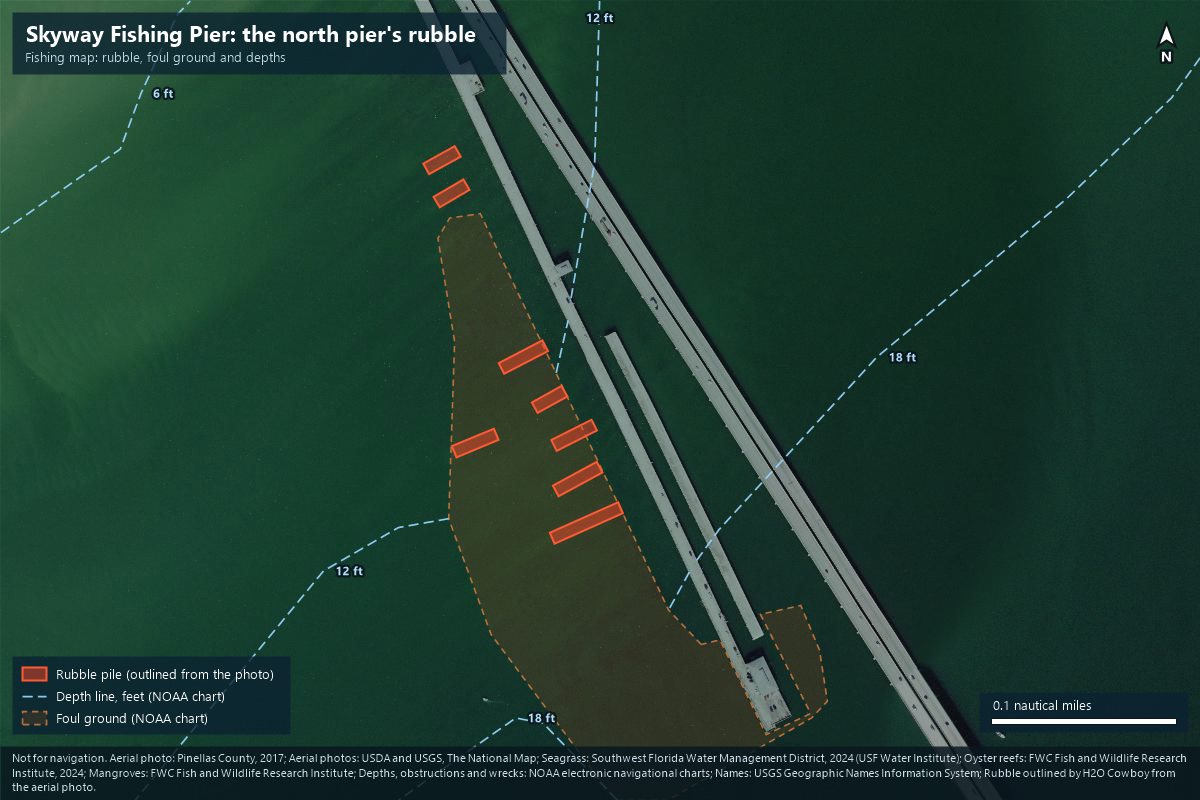
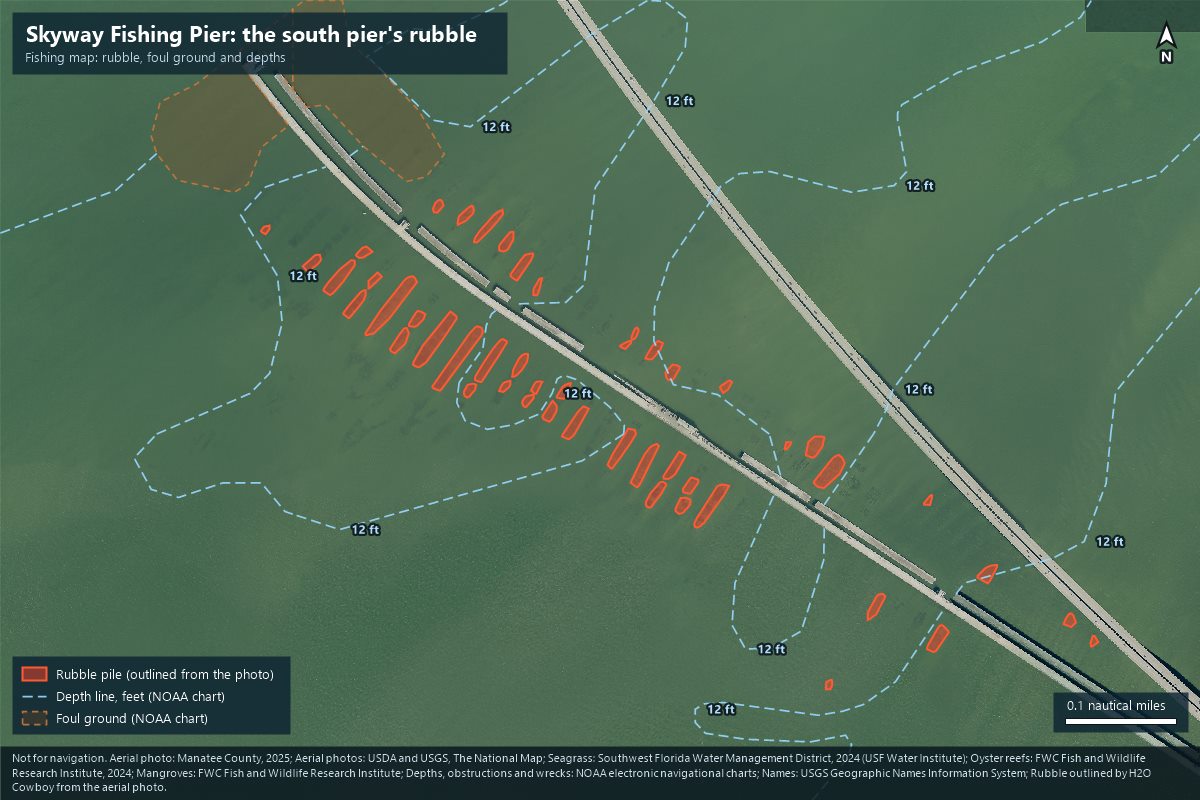
The old bridge is still on the bottom. Its concrete and steel were laid beside the piers in rows of artificial reef, each about 40 feet wide, 4 feet high and 150 to 300 feet long, in 12 to 15 feet of water: 18 rows off the west (Gulf) side of the north pier, from about the middle of the pier out to the end, and 55 at the south pier, 25 on the bay side and 30 on the Gulf side. They've grown over with soft corals, barnacles and anemones, and they're where the pier's grouper and snapper live. Charts mark foul bottom off both pier ends, and more of the old bridge lies along its old line near the ship channel. Concrete from the eastern spans torn down in 2011 and 2012 went to two Manatee County artificial reefs: Southeast Tampa Bay Bridge Reef, in about 15 feet of water in the lower bay, and 3 Mile North Bridge Reef in the Gulf.
Each pier has a bait shop that sells bait, tackle, snacks and drinks and rents gear, and there are restrooms. Admission is $4 per vehicle plus $4 per adult ($2 for children 6 to 12, free for 5 and under); walk-ins and cyclists pay $4. Admission covers your saltwater fishing license for 24 hours. Pets and alcohol aren't allowed, and RVs, trailers, large trucks and vehicles over 12 tons can't drive onto the piers. Snook, tarpon, grouper, Spanish and king mackerel, cobia, sheepshead, snapper, pompano and black sea bass are all regular catches.
Since Oct. 27, 2025, after FDOT structural inspections, there's been no vehicle or foot access beyond the bait shop on the south pier; about 0.6 mile of that pier, which is nearly 2 miles long, is closed. Since March 16, 2026 the south pier has had no power, limited bait-shop service and limited lighting at night. The north pier stayed fully open. In March 2026 the state announced it would replace the south pier with a new one beside it, fix up the north pier to last about 20 more years, and tear down the old south pier and the north pier's unused, damaged sections, with temporary piers to keep people fishing during the work. FDOT's plan calls for a new concrete pier about a mile long beside the existing south pier, open only to pedestrians and emergency vehicles, and four 200-foot timber piers along the south pier's access road. As of late September 2026 the project was still in design, FDOT had cancelled its first contract advertisement in May to re-advertise it with a revised scope, no completion date had been announced, and fishing access is to stay open throughout the work.
How to fish it
Current drives the bite here. The piers run beside the main ship channel at the mouth of the bay, where the whole bay drains in and out under the spans, so plan around the strongest flows of the day (NOAA's PORTS current meter at the Skyway shows them live). Bring heavier tackle than you'd use on the flats, with 2 to 4 ounces of lead at the least to hold bottom and more on the biggest tides.
Catch bait on the pier when you can. From March 16 through November 14, jig a sabiki under the lights, or on the side the current is coming from, for threadfins, pinfish and pigfish. From November 15 through March 15, sabikis and every other rig with more than one hook are illegal on the pier, so bring live shrimp or buy bait at the bait shop.
Grouper and mangrove snapper live on the rubble rows. On the north pier the rows are all off the west side, from about the middle of the pier out to the end; at the south pier they're on both sides, but the outermost ones are past the closed stretch for now. The fishing map below shows the rows we could make out in aerial photos, most of them starting about 100 feet off the rail. With the east spans gone, the outgoing tide is the one that carries a bait from the north pier's deck out over its rows, and the first of the outgoing is the time to be there. Let the current walk a bait out to the rocks rather than casting onto them, and fish the slower water around the turns rather than the hardest flow. For grouper, go heavy: at least 80-pound braid, an 80- to 100-pound leader, an 8/0 to 10/0 circle hook and the drag set hard. Hook a live pinfish or grunt near the tail so it swims down, turn the fish before it gets back into the rocks, and expect to lose some rigs. Mangrove snapper sit tight to the rocks and pilings on the deeper edges: fish a small pilchard or shrimp on a #2 to #4 hook and a 15- to 20-pound leader, early on a high tide, on the first of the outgoing and at dusk.
Spring, from March into May, is mackerel time: Spanish mackerel run past the piers, kingfish show along the outer spans, and cobia and pompano work the pilings. A second run of Spanish and kings comes through in the fall, with bluefish. When birds work bait, throw spoons or jigs into the school, or fish a live baitfish for kings and cobia. In the winter rule season, use single-hook lures only.
Summer nights belong to tarpon and snook. The lights pull bait in after dark: drift a live threadfin or pinfish along the edge of the light, or work a plug through it. Mangrove snapper bite on the rubble through the summer, and big jacks and sharks show up too.
In winter, sheepshead gather on the pilings. Fish shrimp or fiddler crabs on one small, strong hook with a split shot, or on a knocker rig that keeps the bait tight to the piling. Gag grouper move onto the rubble rows as the water cools; check the gag season before you keep one, since it has been short. Pompano and silver trout bite through the cool months too.
The deck stands more than 20 feet above the water, so land anything heavier than a few pounds with a hoop net or pier net (the bait shops sell and rent them) rather than lifting it on the line. Never haul a big tarpon up the rail; tarpon over 40 inches should stay in the water. If you hook a pelican or another seabird, don't cut the line: a bird trailing line can tangle itself and others and die. Reel it in slowly and keep it on the water until you can lift it with a net, then cover its head with a towel or shirt, hold its wings against its body and keep a pelican's bill slightly open so it can breathe. Cut the barb off, back the hook out and clip away any line wrapped around it. If it has swallowed the hook or is badly hurt, call a seabird rescuer instead.